
Table of Contents
There’s a moment on every high-stakes job site — amid the hiss of welding torches, the dust of a half-finished high-rise, or the eerie quiet of a building mid-renovation — when the standard safety net simply isn’t enough. Sprinkler systems go offline. Fire alarms get disconnected for repairs. And in those critical windows of vulnerability, fire watch guards become the most important people on the premises. These aren’t glorified flashlight carriers. They are trained safety professionals standing between an ordinary workday and a catastrophic loss of life and property.
The fire protection system market tells the story in numbers. The global industry is projected to grow from $85 billion in 2025 to over $118 billion by 2030 — a CAGR of 6.8% that reflects just how seriously the built world is taking fire risk. And at the human center of that ecosystem, fire watch services remain a cornerstone that no automated system has yet replaced.
What Exactly Is a Fire Watch Guard?
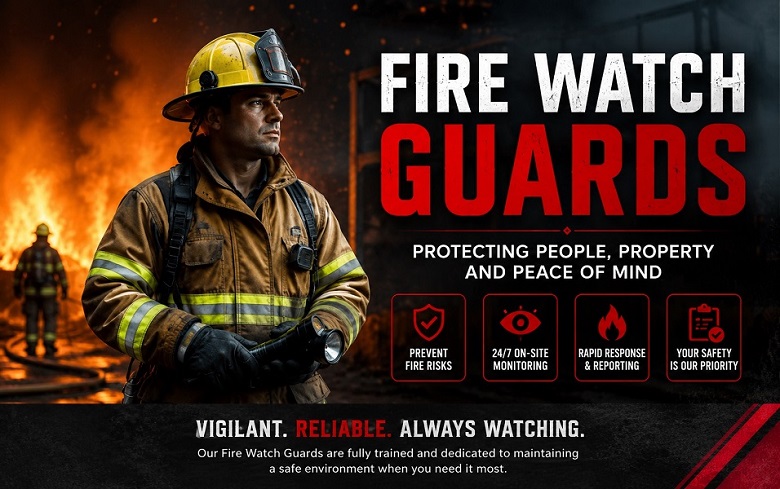
Strip away the jargon and the answer is deceptively simple: a fire watch guard is a trained individual deployed to monitor a location for fire hazards when the standard suppression and detection systems are unavailable or compromised. Think of them as the immune system of a building — invisible when everything else is working, absolutely essential when it isn’t.
The scenarios that trigger a fire watch deployment are more common than most property owners realize. A sprinkler system goes down for routine maintenance. A construction crew needs to run welding arcs through an occupied commercial structure. An emergency repair in a warehouse floods the electrical system with risk. In each case, OSHA guidelines and local fire codes don’t just recommend a fire watch — they legally mandate one.
The role traces its roots to industrial-era workplaces, where hot work processes created fire risks that outpaced the firefighting technology of the time. Today, the concept has evolved dramatically, blending traditional human vigilance with modern communication tools, digital logging systems, and formal compliance protocols.
The Real Duties Behind the Badge
Ask most people what a fire watch guard does, and they’ll say “walk around and look for fires.” That answer undersells the role by a wide margin.
A professional fire watch guard conducts structured patrol rounds — typically every 15 to 30 minutes — covering every corner of a designated zone. They’re trained to recognize fire hazards before ignition: flammable materials stored too close to heat sources, blocked emergency exits, overloaded circuits, and improperly stored chemicals. Their eyes are calibrated to see what untrained eyes miss.
Beyond patrol, they maintain direct communication channels with local fire departments and internal emergency response teams. If smoke appears or a spark catches, they don’t freeze — they activate. Sounding alarms, coordinating evacuations, and guiding first responders to the exact origin point of a hazard are all part of the job description. That calm, practiced response under pressure is a product of rigorous training, not instinct.
Equipment inspection is another underappreciated dimension of the role. Fire watch guards are responsible for verifying that extinguishers are accessible, within inspection date, properly mounted, and labeled correctly. In many U.S. states, failure on this front doesn’t just create liability — it’s a code violation that can shut down an entire job site.
Documentation: The Overlooked Power of Paper Trails
Here’s something the industry doesn’t talk about enough: the paper trail a fire watch guard creates is often just as valuable as their physical presence.
Time-stamped patrol logs, hazard identification records, corrective action notes, and supervisor sign-offs don’t just satisfy insurance companies and fire marshals. They create a living record of a facility’s safety culture — one that can defend a business in litigation, speed up insurance claims, and reveal patterns of recurring risk that management might otherwise overlook.
When a fire marshal walks onto a site for an inspection, a well-maintained fire watch log signals professionalism and preparedness. It demonstrates that the organization takes its legal obligations seriously. In an era where a single fire incident can generate millions in liability, that documentation is a form of financial protection as much as a safety protocol.
When the Law Demands You Act
Understanding when a fire watch is legally required isn’t optional — it’s a business imperative.
OSHA standards and National Fire Protection Association (NFPA) codes, particularly NFPA 101 and NFPA 241, are the governing frameworks across most U.S. jurisdictions. The threshold is clear: when a fire alarm or sprinkler system has been offline for more than four hours in a 24-hour period, a fire watch must be activated. Hot work — welding, cutting, brazing, soldering — triggers its own set of requirements, often demanding a fire watch during operations and for a full 30 to 60 minutes after work concludes.
Construction and renovation environments carry perpetual risk of code gaps. When a building is mid-transformation, its fire suppression infrastructure is frequently compromised in stages. Developers and general contractors who skip or shortchange fire watch coverage aren’t just gambling with lives — they’re inviting OSHA citations, project shutdowns, and the kind of regulatory scrutiny that can unravel timelines and budgets entirely.
The Human Factor in a Tech-Driven Safety Industry
There’s a temptation in the current moment to believe that AI, IoT sensors, and smart building systems have rendered human monitoring obsolete. The fire automation market is growing fast, with projections suggesting it will nearly double from $10.5 billion in 2024 to over $20 billion by 2033. These technologies are remarkable — and they’re partners to human fire watch services, not replacements.
No algorithm can make a judgment call the moment a welding spark lands on an unseen pile of rags. No sensor network can read a room’s atmosphere the way a trained professional can, noticing the subtle chemical smell of overheating insulation before any detector trips. The human element — present, thinking, and responsive — remains the irreplaceable core of fire watch security.
That’s precisely why companies like Just Fire Watch have built entire service models around deploying certified, experienced guards whose sole focus is fire hazard vigilance. In a crowded security services industry where generalist firms often tack fire watch onto their service menu as an afterthought, dedicated fire watch providers offer something qualitatively different: depth, specialization, and accountability.
Choosing the Right Fire Watch Service
Not all fire watch services are created equal, and the differences matter enormously when the stakes involve human lives and property worth millions.
Certification and training are the baseline. Guards should be trained in fire prevention, suppression equipment operation, emergency communication, and OSHA compliance standards. Ask any prospective provider for proof of training documentation and ask specifically about their protocols for hot work monitoring versus system-outage scenarios — they require different skill sets and patrol frequencies.
Response time and coverage continuity are equally critical. A fire watch service that can’t guarantee 24/7 deployment or has gaps in staffing rotation is a liability, not a safeguard. The value of a fire watch exists precisely because risk doesn’t run on a business-hours schedule.
Finally, look for providers who deliver detailed, verifiable documentation — digital logs, real-time reporting, and post-deployment summary reports. In the event of an incident or inspection, that paper trail becomes your most powerful asset.
Why This Role Is Only Growing in Importance
Urban density is increasing. Construction timelines are compressing. Aging infrastructure means more systems requiring temporary shutdowns for upgrades. And as buildings grow smarter, the periods during which they’re vulnerable — when old systems are disconnected before new ones come online — create exactly the conditions that fire watch guards exist to cover.
The businesses, developers, and facility managers who treat fire watch as a checkbox exercise are the ones who end up making headlines for the wrong reasons. Those who understand it as a genuine safety investment — one that integrates human expertise with compliance protocols and real-time response capability — build reputations for professionalism that compounds over time.
A fire watch guard standing post at 2 a.m. on a construction site isn’t just doing a job. They’re holding the line between a controlled environment and an uncontrolled catastrophe. That’s a role worth understanding, respecting, and investing in.